

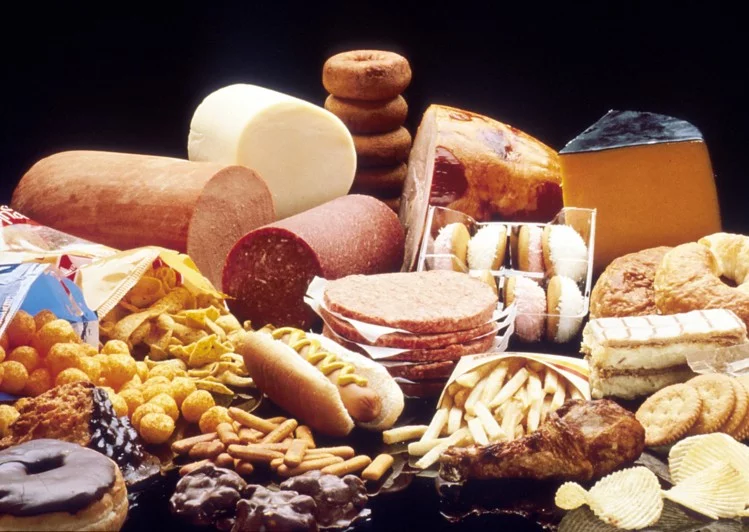
What do the different numbers we see in a cholesterol test result mean? What do low-density lipoproteins (LDL) represent, for example, and why should their results be low compared to the other high-density ones? Where is the cholesterol and what is it? How do the fats we eat and their types affect this? Then we hear about Omega-3 and Omega-6, and the picture becomes even more complex.
Fats in Food
In the beginning, saturated fats are known by this name in view of their chemical nature, as they are saturated with hydrogen atoms. Even if that chemical composition does not concern the consumer, the main distinction of these fats is that they can be solid at room temperature, such as coconut fat (oil), which contains 87% saturated fat.
As for unsaturated fats, they are of two types: monounsaturated fat and polyunsaturated fat. In their digestion path, they resemble the path of saturated fats until they reach the liver, where they are directed differently, as both saturated and unsaturated fats affect the liver’s function in different ways. When we hear about types of fats like Omega-3 and 6, these are polyunsaturated fats, while Omega-7 and 9 are monounsaturated fats. As for trans fats, they are mostly industrial fats, but they are present in some foods, and despite being unsaturated, they behave like saturated fats, as we will see.
Every fat we eat contains a mixture of several substances, fatty acids, and several types of fats at the same time. For example, olive oil contains a low percentage of saturated fat, 73% monounsaturated fat, and a low percentage of polyunsaturated fat. Most dairy fat products, such as butter, cheese, and milk, are two-thirds saturated fat and one-third monounsaturated. This is also the case with meat and fish, which contain a mixture of saturated and unsaturated fats: monounsaturated and polyunsaturated.
Different studies and health guidelines (such as those from the American Heart Association) recommend reducing the percentage of saturated fats to below 10% of total daily calories (or less, such as 5-6% for better prevention). Many studies find that replacing saturated fats with monounsaturated or polyunsaturated fats contributes to reducing the risk of cardiovascular disease.
Lipoproteins: Fat Transport Vehicles
A large part of a lipid test result is nothing more than a test of the percentage of “fat transport vehicles” in the blood, from which we infer the quality of the fats present and the nature of the body’s activity in processing them. Lipoproteins known as chylomicrons, low-density lipoproteins (LDL), high-density lipoproteins (HDL), and very-low-density lipoproteins (VLDL) are the body’s vehicles for transporting triglycerides and cholesterol into the blood.
After the processing of fats in the small intestine is finished, the resulting triglycerides are ready to be transported to parts of the body via what is known as the exogenous pathway, which occurs via chylomicrons, which we do not usually see in lipid tests. Once the chylomicrons reach the cells in the body, they deliver their triglyceride content.
The second pathway for processing fats is the endogenous pathway, which comes from our excess food consumption or other metabolic causes, such as the conversion of excess carbohydrates into fats in the liver. Excess saturated fats in the liver—whether via sugar conversion or from the diet—interact with low-density lipoprotein (LDL) receptors in different ways and cause the suppression of those receptors’ activity, thus leading the liver to produce a lot of low-density lipoproteins (LDL). But what is the problem? We have a lot of saturated fats, so let us have all the vehicles we need to transport them, right? Not exactly.[1]
The human body has the ability to produce several types of lipoproteins that undertake the task of transporting cholesterol and triglycerides. What performs the main task is the very-low-density lipoproteins, known as VLDL. There is no need to generate a lot of LDL, as VLDL performs a large part of the task and gradually transforms, after dropping its load, into LDL carrying cholesterol, then heads to the liver to be recycled there. Low-density lipoproteins are also not safe as vehicles traveling in the bloodstream.
In a healthy state, low-density lipoproteins are recycled and disposed of. However, in an unhealthy state with the consumption of a lot of saturated fats, these proteins continue to travel in the blood while carrying cholesterol. Also, these lipoproteins are not fixed in size; LDL proteins are either large (which are less dangerous) or small in size. It is noted in cases of high triglyceride levels that there is an abundance of these small-sized particles, which can get stuck within the walls of blood vessels, causing their cholesterol load to accumulate there. Conversely, the presence of a lot of the other type of vehicle, which is high-density lipoprotein (HDL), indicates a good situation where the body has sufficient ability to dispose of excess cholesterol.
Low-density lipoproteins thus resemble transport trucks, while high-density proteins resemble garbage collection trucks that pick up excess cholesterol from blood vessels and cells. Since there is a lot being transported versus little being collected for disposal, the danger of gradual blood vessel blockage manifests here. When the high-density vehicles (HDL) reach the liver, the cholesterol is converted for use in making bile acid or is excreted via feces. The hero of the cholesterol disposal task is primarily high-density lipoproteins.
For this reason, we find values with these names in a lipid test, and through them, we can know the quality of the fats we eat. The healthy state is represented by balanced ratios between those high-density and low-density vehicles. While consuming a lot of saturated fats leads to an increase in low-density vehicles, consuming healthy fats does not have the same effect on HDL; rather, its percentage increases in a different way.
With the consumption of a lot of unhealthy foods exceeding our needs, the processing of excess fat is shifted to the liver, and the percentage of VLDL rises, as well as LDL, to carry excess triglycerides to the body. In light of those changes, HDL is used to carry larger amounts of triglycerides instead of cholesterol, which makes it vulnerable to destruction via a specific mechanism. The enzyme responsible for this is known as Cholesteryl Ester Transfer Protein (CETP). Through this mechanism, the percentage of high-density lipoproteins that help us get rid of excess cholesterol decreases. In a healthy state, HDL specializes in carrying cholesterol in the absence of a lot of excess triglycerides. Therefore, reducing sugar—which leads to the formation of excess triglycerides—is a successful way to increase HDL.
Trans fats, through their behavior, cause an increase in LDL and contribute even more to the increase of the CETP enzyme, which leads to the activation of a mechanism in which high-density lipoproteins are destroyed.
Unsaturated fats affect low-density lipoprotein receptors, improving their effectiveness, and thus they reduce the formation of low-density vehicles.
Triglycerides and Cholesterol
The triglycerides we see in a blood test come primarily from the fats we eat and are transported via chylomicrons to the blood from the digestive tract. However, excess sugars are also converted into triglycerides via the liver, which activates the other pathway and vehicles we discussed. Triglycerides are used as fuel and are necessary as a source of energy. The excess is also stored in fatty tissues. To avoid gaining weight, you should not have a lot of excess triglycerides or those converted from excess carbohydrates.
As for cholesterol, it is a fatty, waxy substance used in building the body and is not used as energy; it is very necessary for life. However, its increase is not healthy. The body manufactures about 80% of its cholesterol; nonetheless, some foods like red meat and eggs contain some cholesterol.
.
References
Feingold, Kenneth R. “Introduction to lipids and lipoproteins.” Endotext [internet] (2024).
Trevaskis, Natalie L., et al. “Intestinal lymph flow, and lipid and drug transport scale allometrically from pre-clinical species to humans.” Frontiers in physiology 11 (2020): 458.
Dr Lewis Potter, Cholesterol Metabolism, geekymedics.com, November 11, 2010
Reverse cholesterol transport, Wikipedia
[1] Mustad, Vikkie A., et al. “Reducing saturated fat intake is associated with increased levels of LDL receptors on mononuclear cells in healthy men and women.” Journal of lipid research 38.3 (1997): 459-468.
0 Comments