
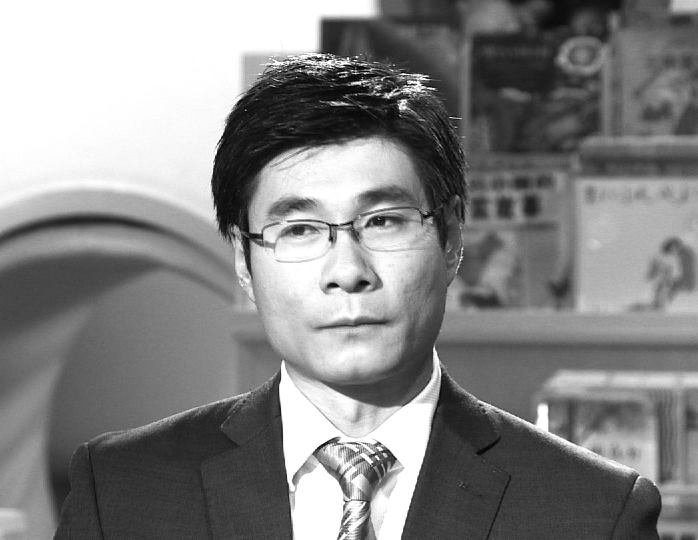
A Chinese individual known as Professor Jiang, whose real name is Xueqin Jiang, has recently gained fame. He has issued several predictions, including a joint U.S. and Israeli attack on Iran, a ground invasion of Iran by America, and the demolition of the Al-Aqsa Mosque by the Israelis while blaming Iran. But why discuss this on Real Sciences? The reason is that “Professor” Jiang does not present his claims as mere political analysis, but rather as a scientific theory based on game theory, utilizing an academic setting to deliver his predictions and statements. By doing so, he presents himself as either an academic, a researcher, or a scientist, or he frames his conjectures with a pseudo-academic or pseudoscientific veneer.
Who is Professor Jiang?
On his LinkedIn page, we see that Xueqin Jiang studied English Literature at Yale University in the late 1990s. He then worked as a teacher in various schools in China and served as an editor for the New York Times China branch for one year. In a 2014 article, he is identified as an expert in Chinese education, but there is no mention of him being a political expert or a professor. [1] The article mentions that he immigrated to Canada with his parents at a young age, and he claims to have lived there since he was six years old, though it is clear that his accent does not match that of a native Canadian.
A Wikipedia entry on Jiang states that he filmed videos for an American channel in violation of Chinese regulations, leading to a two-day detention before his release. He appears to have returned to China normally afterward, then later left to become a dissident; he has an article on CNN describing the Chinese media as a facilitator of tyranny and corruption. [2] In one of his lectures, he claims that communism is a capitalist conspiracy, and it is unclear if this is related to his stance on China.
Fundamentally, Professor Jiang is not a professor and does not lecture at a university. If he has expertise in any field, it is education, having worked in teaching and schools for nearly 20 years. Most of the videos or “lectures” he provides are for a small group of followers and are not held within an academic institution, despite his attempts to give that impression.
Signs of an Imposter in Political Forecasting
Jiang became famous because he posted a video in 2024 claiming that Trump would return to power and go to war with Iran. Consequently, certain influential websites drew attention to him as a forecaster of events—a role he focuses on more than the actual details of his claims. Jiang says he understands history to predict the future, and his YouTube channel is titled “Predictive History.”
Jiang provides “Yes or No” predictions regarding major key events that have no third alternative. With the ongoing escalation by the United States against Iran for over twenty years, this question can be asked dozens of times and answered with a “Yes” or “No” each time. The same applies to Trump’s rise to the presidency; we were not talking about 50 candidates, but a choice between Trump and Kamala Harris. These are not considered predictions by the standards of political science. Anyone with zero knowledge could simply flip a coin and decide on a set of probabilities with “Yes” and “No” answers. Using vague language and even vaguer criteria – such as who will win in a U.S. attack on Iran – provides Jiang with many loopholes.
In his book on superforecasters, Philip Tetlock explains the characteristics of that group. Tetlock is an expert in political psychology who was commissioned as part of a group of scientists to develop a program to improve the forecasts of U.S. intelligence officers. He is the director of “The Good Judgment Project,” which specializes in refining forecasting skills. What kind of forecasting is Tetlock talking about? Here are simple points to identify a good political forecaster (those whose accuracy exceeds 60%):
- The forecaster must provide a percentage for what they believe will happen. Tetlock says that anyone who speaks with absolute certainty (100%) was never among the good forecasters and was often among the worst. Good forecasters in intelligence agencies provide percentages. For example, he mentions that the analyst who located Osama bin Laden provided a range of percentages over time regarding the analysis that he was in a specific location until it exceeded 90%, at which point the strike was carried out. A good analyst must provide percentages and be able to explain them precisely.
- The forecaster must explain their claims according to clear, measurable foundations, rather than staking their credibility on “If Israel does not strike Al-Aqsa, do not follow me and I will stop speaking about politics,” as Jiang does. A forecaster should explain their process much like a solution is explained in physics or chemistry. Breaking down a major decision into small parts and probabilities is what these people do. We see none of this with Jiang. Imagine buying a pair of pants: one salesperson explains the quality of the fabric in detail and provides evidence, while another tells you “Don’t buy from me again if something happens to your pants, but I promise these are the best in the world.”
- Political forecasting is not like the prophecies of fortune-tellers. The superforecasters identified by Tetlock did not listen to the “voice of the universe” or a higher being guiding them like Jiang; instead, they create lists, tables, and logic for every prediction they make. They later review why they failed and incorporate the criteria of their errors into future calculations. A growth mindset is part of the behavior of good analysts.
- Tetlock found that superforecasters treat their analyses with an open mind, not with arrogance or rigid attachment to a decision. They also constantly update their analyses based on new data. Even if Jiang happened to be right, what was his data when he predicted the war on Iran? There is plenty of nonsense about “secret organizations” that he talks about as basis for his rationale behind the war, but no real analysis telling us “Why Iran? Why now?”
- Reliance on data and numbers is an essential part of being a good political forecaster.
The Nonsense of Professor Jiang
One of those who brought attention to Jiang with the title of “expert” is Piers Morgan. Morgan is a controversial British media figure, but he is in no position to grant someone the status of a “game theory expert.” This reminds us of the fame Joe Rogan gave to Jordan Peterson, to the point where Peterson’s media fame boosted the value of his writings academically and increased his citations. Are we facing a similar phenomenon? Perhaps it is much worse.
Jiang later added to his predictions that America would lose the war and that Israel would strike the Al-Aqsa Mosque, citing an idea published by an extremist Israeli cleric calling for a strike on Al-Aqsa followed by blaming Iran. But where is the “prediction” in everything Jiang says, and what is the basis that makes him – as he claims – different from fortune-tellers or someone throwing dice to guess what will happen? Fundamentally, Jiang relies on a fictional method called psychohistory, a principle mentioned by Isaac Asimov in a science fiction story as a way to predict the future, not an academic specialty. In reality, Jiang doesn’t even claim to analyze information; he throws out guesses while listening to the “voice of the universe” or a higher voice that he conveys to people in his lectures.
“Everything you were taught in school is wrong,” “There is a secret history” – how did you know this, Jiang? “Roman history is fabricated” – yet he relies on Roman history to prove what he says! For instance, Jiang denies the Punic Wars and Hannibal’s invasion from Tunisia to Rome despite the historical evidence, but he lacks even the knowledge of that evidence. For Jiang, “the theory of evolution is wrong” as well. This is in addition to his claims of being connected to a higher power! Jiang does not deal with historical analysis of events and facts, but with “speculative analysis,” as he calls it. “The universe communicates with me so that I can communicate with others.” [3]
Jiang engages in a world of interpretations regarding ancient gods, their symbolism, and pseudoscience concerning the pyramids, merging them with false information from psychology. For example, he goes into depth explaining how Pharaohs were controlled by priests—something never mentioned by any evidence, text, or scholar in the field of Egyptology, regardless of their varying opinions.
As for Jiang’s talk on game theory, it is more nonsense. If you read the basics of game theory, you will find specific frameworks and rules that Jiang neither adheres to nor explains. The first step in game theory is mathematical modelling. You cannot say you are speaking about game theory if you have no numbers to discuss. All Jiang does is describe some non-measurable criteria such as “vanity” or “nervousness,” which are foundations of his analysis; while these are fine to discuss, they shouldn’t be called “game theory.” This is another fabrication.
Perhaps the level of nonsense on the other side—the U.S. administration and the ignorance of the motives driving decisions and wars—is the reason for the rise of charlatans like Jiang, as if that level of nonsense is the global language of today. We must also wonder, in a world where social media is subject to the rule of specific parties rather than the rule of viewing algorithms: Why did Jiang appear, and why did he become famous?
References
[1] Ian Johnson, Solving China’s Schools: An Interview with Jiang Xueqin, NY Books, 2014.
[2] Jiang Xueqin, China’s media enables tyranny and corruption, CNN, 2017.
[3] Archaeology with Flint Dibble, “Debunking the Fake Historian Taking Over the Internet”, YouTube.
0 Comments