
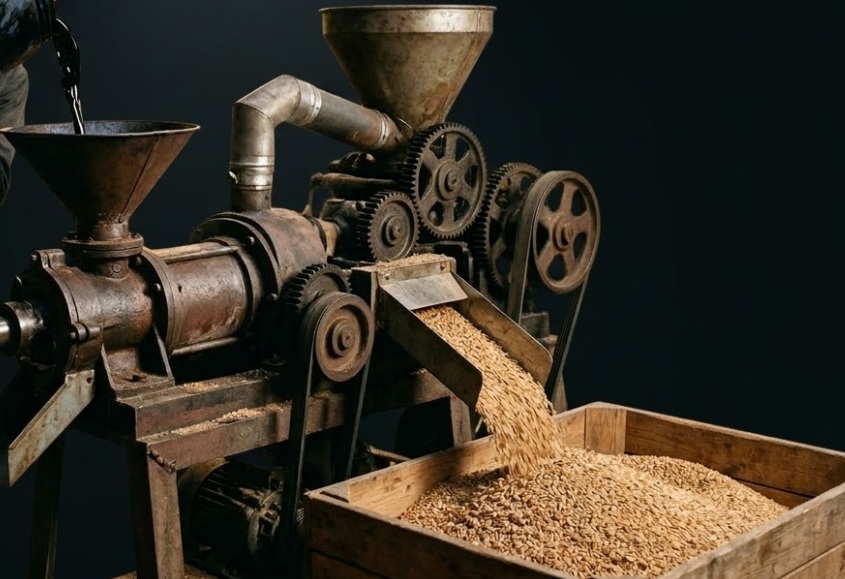
Whatever you may have heard about the rising temperature of the planet due to human industrial activity, it is only a small part of the picture regarding how we use fossil fuels, primarily oil. Our food depends fundamentally on oil, and oil is subject to numerous political interactions; it is also prone to depletion, just as it has run out in many parts of the world. This article includes a reading and presentation of some of the facts mentioned by American geologist Dale Allen Pfeiffer in his book: “Eating Fossil Fuels: Oil, Food and the Coming Crisis in Agriculture.”
Over the last two hundred years, agriculture has passed through two stages. The first was the use of mechanization in the nineteenth century, which took a long time to spread throughout the world. Then came what is known as the Green Revolution in the 1960s, which introduced more modern machinery that relies on oil for its operation. The role of oil in this was far greater than just its mention in the agricultural revolution. Many who read these lines would not exist, just as the devices they carry and read from would not exist, if not for oil. Oil is not just a means for operating airplanes and cars and generating electricity; it triggered a major revolution in agriculture that led to a massive increase in our population.
Oil is used to operate agricultural machinery and to generate electricity for drawing groundwater or directing and pumping water toward agricultural lands or spraying it. Oil is also used in the manufacture of fertilizers, without which agriculture cannot take place in many lands across the world. Additionally, oil is used in harvesting, food transport, cooking, cooling, storage, and canning. In most countries of the world, all these production lines and paths remain entirely dependent on oil. The world has witnessed agricultural disasters when the presence of oil ended suddenly in a particular country.
North Korea used to receive a modest share of oil from the Soviet Union, enabling it to operate agricultural machinery and manufacture fertilizers. When the Soviet Union collapsed, an individual in North Korea was consuming more energy than a Chinese person and about half of what a Japanese person consumed. There were sources based on coal or hydroelectric power. However, a significant portion of the energy consumed by North Korea came from the oil sent by the Soviet Union, which stopped. North Korea began receiving only 40% of the oil it used to get, and China reduced what was known as “friendship grain” from 800,000 tons to 300,000 tons. No aspect of transport, manufacturing, or agricultural equipment operation remained unaffected by that drop in oil. Between the fall of the Soviet Union and 1996, about three million North Koreans died. North Korea did not recover its agricultural production or its population count even after it was able to obtain a larger amount of oil. As for Cuba, which was a less severe case, the daily per capita consumption dropped from 2,700 kcal to 1,800 kcal.
Oil affects our ability to farm. When North Korea lacked oil, people began working in the fields themselves; consequently, they needed more energy to work, and their production efficiency was lower. Furthermore, the number of people required to work in agriculture increases, leading to a significant decline in other sectors needed by modern states. When oil affects agriculture, it affects our population count. The 1990s witnessed a decline in North Korea’s population growth rate from 1.4% to less than 0.5% in 2002. Moreover, a decrease in oil means a decrease in capability and an increase in the cost of transport, upon which nutrition in many parts of the world depends.
Researchers in Sweden calculated the distance that a breakfast meal, with all its contents, traveled before reaching Sweden and found that it was equivalent to the Earth’s circumference. All that energy comes from oil. Until now, the transport sector, especially shipping vessels, remains a sector heavily dependent on oil. Not only this, but the human capacity to cook food has increased greatly because of oil; even in developed countries that replace oil at good rates, gas is still in use for heating and cooking.
Since there is so much food that humans have multiplied and become several times what they were before the agricultural revolution, the level of nutrition or abundance of food is something that did not occur as a result of that, even in regions that produce food abundantly like the United States. Dale Allen Pfeiffer says:
“In spite of a 70 percent population increase, the Green Revolution has led to a 17 percent increase in calories available per
person. Everyone in the world could have a daily intake of at least 2,720 kilocalories (1 kilocalorie = 1,000 calories) if food were distributed more equitably. Yet, there were still an estimated 798 million undernourished people in developing countries as of 1999-2000. This is a decrease of only 19 million from the 1990-1992 estimate”
In truth, even in the countries with the most abundant agricultural production, we have not eliminated malnutrition and hunger through the agricultural revolution. More humans are born to suffer from hunger and malnutrition. In the United States, more than 10% of families are not considered food secure, and the count reaches one-third of families when there is a family dependent on a single mother. We are talking about the most food-producing country in the world.
For every calorie you consume, 10 calories of hydrocarbons, such as oil, are burned. The need of agriculture for energy has increased fifty-fold from the past, when humans and animals performed the work with some simple machines. In some cases and regions of the world, energy consumption by agriculture increased a hundred-fold after the agricultural revolution. We did not get more sunlight or more land; rather, there were fertilizers, pesticides, and irrigation equipment so that production could increase, all under the auspices of oil. Aside from the oil energy required to produce food, the energy required for a single family exceeds what the family needs to produce food by 48%, including 40% of the energy used in freezing food.
For every birthday cake, plate of sweets, piece of chocolate, or fat-filled meal in restaurants, there is oil being burned so that you can obtain this food. For an American individual, for example, there are 400 gallons of fuel burned for one person to get their food. If we did not have oil, each person (according to the food Americans eat) would need three weeks of work to produce the food eaten by one person for one day! Taking into account that Americans’ consumption of energy and food is higher, this does not change the fact that the reality may be similar in many countries depending on the individual’s lifestyle as well.
But have we begun to eat better or farm better? How does agriculture in those massive quantities affect the soil, and how will we leave the planet for those after us? The book talks about lands that are no longer suitable for farming without fertilizers, while the best and most sustainable solution is crop rotation, something only Cuba applies due to its inability to provide enough energy to manufacture fertilizers. Groundwater has also been consumed to a large extent in many regions of the world, such as northern India (specifically Punjab), China, and the Arabian Peninsula. In the United States, 20% of agricultural lands are irrigated by pumping groundwater to the land, which also consumes oil through pumps.
The current use of land, relying on fertilizers and agriculture and converting forest lands to produce food, all leads to cases of land degradation that cannot be repaired except over decades. We farm a lot and consume energy and land for it, but it is not just that we are using resources prone to depletion; we are exposing the soil, water, and energy needed by future generations to permanent damage. In Saudi Arabia, the decline in groundwater has reached rates of up to 30% in recent decades as a result of that oil-based agriculture. However, the impacts of farming using fertilizers and its effects on life in the water make the picture worse regarding water pollution recorded in many countries.
But where is the problem, since we can continue consuming oil and surviving with these billions of people by sustaining this modern agriculture? The problem, besides what we mentioned regarding soil and water damage, is the depletion of oil. Oil is not an infinite source; it is a scarce material that has run out in many large wells in the world. However, the end of oil is gradual, as the energy required to extract a barrel increases. One day, extracting 100 barrels of oil was done using energy derived from one barrel; today, the world average is 5:1. The world has turned more toward gas, which is slightly behind oil in its depletion date, but the depletion of gas in a field is something that happens in a single moment rather than gradually and with an increase in extraction price. Any threat to oil in the world will lead to a collapse that begins, above all, with fertilizers and ends with cooking and freezing energy and food transport, passing through the water, irrigation, and agricultural mechanization crisis, all of which will not work without oil.
What happened to North Korea suddenly in the nineties can happen to any other country where oil runs out or becomes more expensive. What North Korea faced, the absence of fertilizers, the poor quality of land as a result of long-term farming dependent on fertilizers, and the absence of agricultural equipment, all of this is happening and can happen on a wider scale, potentially leading to famines and disasters. The proverb says in the Arabic story where the old man plants: “They planted so we ate, and we plant so they may eat,” referring to the fact that he will not eat from the fruits of the palm he plants, but at the same time, he ate from palms he did not plant. We must be careful, perhaps not only about the food security of future generations but our food security in this decade or in the current oil crisis.
0 Comments