

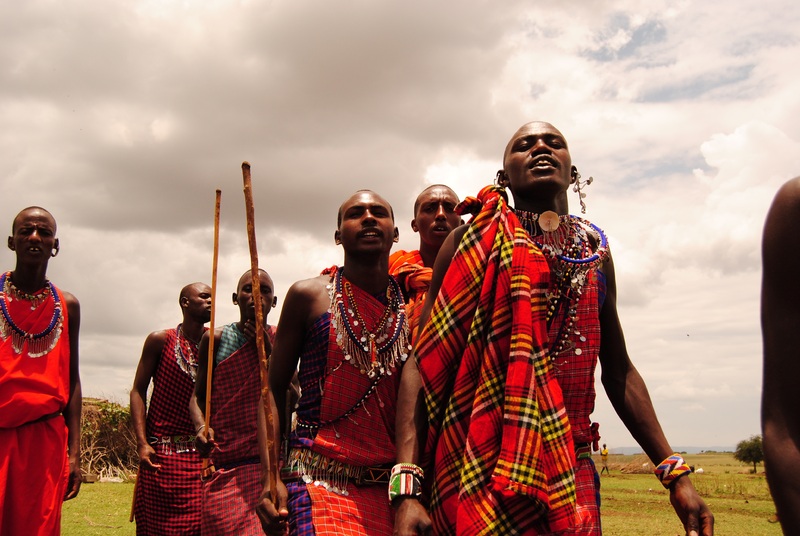
In one experiment, individuals from Western countries were able to identify emotions with 85% accuracy in fellow Westerners, but their accuracy dropped to 72% when shown images of people from non-Western countries. However, you might wonder here: what terms were used for people to guess those emotions? In fact, that experiment involved displaying a checklist of emotions. Yet, when the photos of faces were shown without the written list, the guessing accuracy plummeted to a maximum of 58%.
Emotions Across Cultures
In a similar context, a group of scientists traveled to Namibia in Africa to understand whether emotions are a universal concept shared by all humans. The Himba were a tribe whose people lived a simple lifestyle with no communication or contact with Western civilization. The surprise was that the Himba did not share the same emotions; instead, they had descriptive labels for faces, such as “laughing” for someone whose mouth appeared to be laughing, and “looking” for someone with wide-open eyes. The five emotions you see in Facebook interaction reactions were completely unknown to them.If you believe that the smile is a universal human trait, historical evidence shows that smiling was not common among the Romans and Greeks, and that it did not become widespread and linked to that spectrum of emotions until the advancement of dentistry in the 18th century.
A Note on Arabic Poetry and the Term “Smile”
I attempted to make a comparison based on what I read in Lisa Feldman Barrett’s book regarding the Romans and Greeks, and I found a similar pattern. We see no mention of smiling in the Pre-Islamic era (Jahiliyyah), and mentions of the smile (Al-Ibtisamah) in Arabic poetry remain rare before the 19th century. In the Diwan encyclopedia, I only found it in two instances from the Abbasid era—one by Sari’ al-Ghawani and the other by Al-Mutanabbi:
If you see the lion’s canine teeth bared, do not ever think that the lion is smiling.
There is another case where the smile appears as a physical description of faces, where Ibn al-Rumi says:
Like the faces of the people of Paradise, they smiled upon us, yet paired with the faces of the people of Hellfire.
These were just three instances out of 935 search results in Arabic poetry, all of which were modern, dating after the 19th century. Perhaps the irony here lies in Abu al-Tayyib al-Mutanabbi’s insight that emotions are not necessarily what we see, and that we must not anthropomorphize the emotions of animals.This article is part of a series of articles on the Theory of Constructed Emotion.Some facts in this article are mentioned in How Emotions Are Made of Lisa Feldman-Barrett
0 Comments