

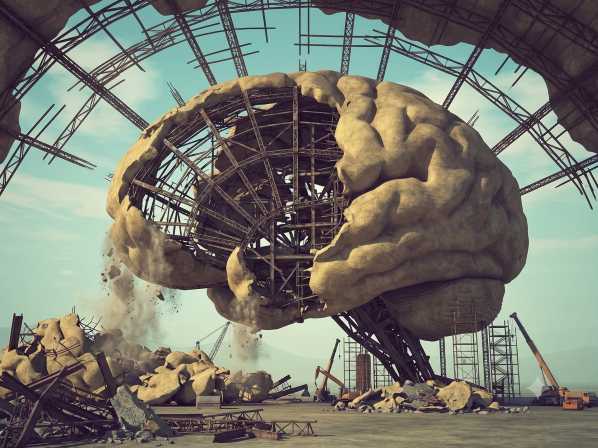
When the Machine Steals the Faculty of Thought
Today, artificial intelligence dominates the cognitive landscape, imposing an invisible gap between the output of the machine and the perception of the human mind. Writing is not merely the lining up of vocabulary or the mechanics of grammar; rather, it represents at its core a complex mental exercise that builds neural connections and sharpens the faculty of critical thinking. With the dawn of tools like ChatGPT, we have faced a major educational and linguistic dilemma. While these technologies grant us texts at the click of a button, they accumulate what is known as “cognitive debt” upon our minds. This modern term warns against the easy embrace of “linguistic delegation”—it yields rapid results in the present, but gradually strips away our capacity for independent creativity and weakens the deep memory formed through the personal effort of crafting sentences and correcting errors.
The Accumulation of Cognitive Debt: How Does AI Lend Us an Illusion?
The concept of “cognitive debt” crystallizes when we replace our own efforts in thinking and analysis with the intelligence of the machine; we are not just cutting down on time here, but borrowing ready-made knowledge that our minds did not build. Research reveals that repeated reliance on these tools disrupts what neuroscientists call the “deep processing” of information. When a student writes an essay through their own effort, their brain is forced to recall vocabulary, adjust verb conjugations, and align context with grammatical rules—a process that consolidates the educational material into long-term memory. However, when these tasks are delegated to AI, the brain stops engaging in this “strenuous exercise,” leading over time to the atrophy of core skills and the accumulation of a cognitive deficit that is difficult to repay in situations requiring improvisation or independent thought.
Language Learning in the Wind: How Rules and Texts Erode
The danger of this “cognitive debt” multiplies when applied to the field of Teaching English to Speakers of Other Languages (TESOL). Language acquisition inherently relies on the “desirable difficulty” that a learner experiences when recalling vocabulary and formulating structures. When a student assigns the task of essay writing to AI, they miss out on the mental struggle necessary to solidify precise rules. The brain does not just need to see the past tense of “catch” or “forget” written correctly; it needs to practice retrieving and applying it in a live context to anchor it in memory. This dependence leads to the rise of a generation of learners who possess dazzling texts but lack the linguistic faculty required to defend their ideas or improvise in a live conversation, transforming language from a tool for communication and thought into a mere tech product devoid of soul and individual personality.
What Happens in the Brain? The Biological Side of “Linguistic Laziness”
The study dives into the neural changes that accompany this technical dependency, revealing how the brain is affected by the mechanism of “automated generation.” The process of creative writing and traditional research activates large areas of the cerebral cortex, specifically those responsible for working memory and executive functions. When a user restricts their role to merely issuing prompts to AI, these neural pathways relax and gradually lose their neuroplasticity. Researchers describe this condition as the “functional disabling of deep processing,” where the brain stops building the new pathways that typically form when solving complex linguistic problems. Instead of the mind functioning as the innovator of the text, its role recedes to that of a “passive observer,” which weakens the capacity for prolonged focus and reduces the efficiency of retrieving previously stored information. This explains the feeling of “cognitive fog” users experience when trying to write independently later on.
The Illusion of Mastery: How the Machine Conceals Flaws in Thinking
The study goes deeper into analyzing the “text quality” produced by AI, uncovering a dangerous linguistic paradox. While sentences appear grammatically correct on the surface, they lack the “deep logical coherence” that characterizes rigorous human writing. Researchers found that users who rely entirely on the machine gradually lose the ability to detect semantic errors or subtle contradictions in the arguments presented. This is attributed to the fact that the brain, in a state of technical dependency, settles for a superficial review of the text without diving into its deeper meanings, leading to the acceptance of weak phrasing or distorted meanings as long as they appear in a sound linguistic mold. The research emphasizes that this decline in critical sense represents the most dangerous aspect of “cognitive debt,” where the learner operates under the illusion that they have mastered the language, while in reality, they have lost control over the tools of logical thinking within it.
Reclaiming the Mind in the Age of the Machine
The concept of “cognitive debt” places us before a mirror of truth. Technology is not merely an assistive tool; it represents an existential challenge to our mental capacities and our authentic language. The study reveals that easing writing tasks via AI carves away a piece of the brain’s neuroplasticity and its capacity for independent innovation. Therefore, the need emerges today, more than ever, to hold fast to self-effort in learning and research, and to safeguard the faculty of thought from technical laziness. The choice remains ours: either we lean on ready-made solutions that strip us of our skills over time, or we choose the harder path that builds free minds, capable of scripting their future with the ink of their own thought.
The Original Research Paper: Your Brain on ChatGPT: Accumulation of Cognitive Debt when Using an AI Assistant for Essay Writing Task
0 Comments